Rufus-Air post-training recipe reading guide
Rufus-Air studies how to turn a public base model into a model with reasoning, instruction following, and agent skills through eight consecutive training stages. Read it to understand the relationship between the starting checkpoint, learnable tasks, reward reliability, and the rollout system. The practical takeaway is to build a broad SFT foundation, refine it with tasks that provide useful reward variation, and preserve the exact sampled trajectory during agent training. The authors document a working recipe; they do not establish that its stage order is optimal. §2.1, pp. 4–5; §6, pp. 30–31.
Authors: Chia-Yuan Chang and colleagues, Amazon. Version reviewed: arXiv 2609.29421v1, submitted 24 September 2026, 47 pages. Guide prepared: 29 September 2026. Study status: pre-read guide; awaiting your reading corrections.
- Original HTML v1 · Original PDF v1
- Read the stored PDF in your browser
- Google Drive backup
- Editable draw.io map · Agentic RL survey · Paper library
- A newer v2 was posted on 25 September. This guide and stored copy deliberately match the v1 link you supplied. Page numbers refer to v1.
Five ideas to carry into your reading
- SFT determines the floor that RL builds on. The base is GLM-4.5-Air-Base, with 106B total and 12B active parameters. SFT uses 9.01M public examples and 27.04B tokens that contribute to the loss. Figure 3 shows loss continuing to fall after held-out scores flatten; checkpoint 3799 is carried into RL. Public datasets can contain upstream model-generated traces even though this team did not regenerate the SFT responses. §3.1, pp. 6–9.
- Group-relative RL needs variation in reward. With a group-mean baseline, equal rewards give no reward-driven advantage. Reasoning RL filters online for mean reward in (0, 0.8]; General Agent and Coding Agent discard all-pass and all-fail groups. Coding RL is an exception: its initial screen drops all-pass tasks, retains tasks with no warm-up success, and is not repeated online. §3.2–3.6; §6, p. 30.
- Stage order follows capability prerequisites and exposure to reward hacking. It is not a strict progression from deterministic to learned rewards: IF RL combines rules and a judge, then the next two agent stages use deterministic verifiers. The authors place open-ended reward-model optimization last. §2.1, pp. 4–5.
- The environment must return the sampled token trajectory. Rufus-Gym alternates inference and tools, then returns token IDs, log probabilities, masks, reward, and a typed termination reason. Retokenizing a textual transcript can change the object being trained. Rollout Routing Replay separately aligns MoE expert choices between rollout and training. §4, pp. 25–27.
- Read each stage against its own starting checkpoint. The final model and intermediate checkpoints can use different evaluation protocols. Table 2 is a collection of local comparisons, not a complete controlled trajectory for every benchmark. §5.2, pp. 29–30.
The eight-stage pipeline
| Stage | Capability being refined | Training signal |
|---|---|---|
| SFT | Broad reasoning, response format, and tool trajectories | Assistant-token supervision |
| Reasoning RL | Math, puzzles, and science | Programmatic answer verification |
| Coding RL | Competitive programming | Execution against selected tests |
| Instruction-Following RL | Exact constraints and retention across turns | Required rubrics, checked by rules or an LLM judge |
| General Agent | Planning, tool calls, and recovery | Final environment-state verifier |
| Coding Agent | Terminal and repository tasks | Tests on the final sandbox state |
| Search Agent | Research on the web | Judge score, tool-use gates, and penalties |
| RLHF | Open-ended response quality | Public reward model with a length penalty |
Each stage starts from the preceding checkpoint. Draw the checkpoint flow separately from the interaction loop inside an agent rollout. Figure 1, p. 4; §3.
Original figures to study
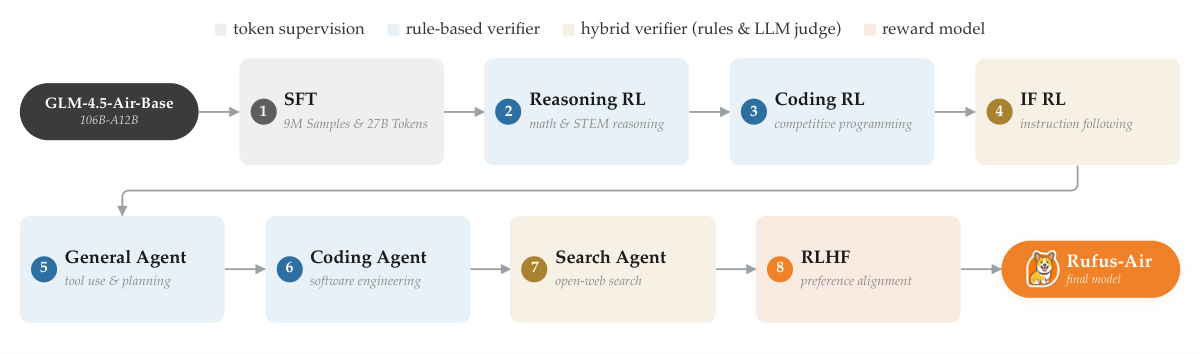
Figure 1, PDF p. 4. Original author figure from arXiv HTML v1, by Chang et al., Amazon. Trace every checkpoint handoff and explain why IF RL appears before two stages with deterministic rewards. This figure describes the recipe; it does not test alternative orders.
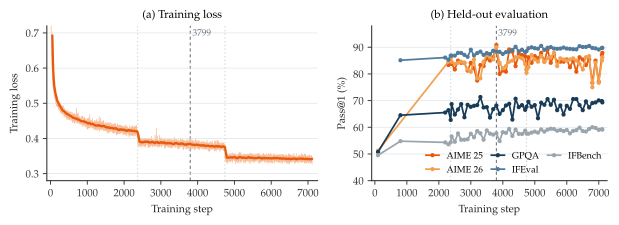
Figure 3, PDF p. 9. Original author figure from arXiv HTML v1. Compare loss with evaluation before deciding which checkpoint to carry forward. The dashed line marks step 3799.
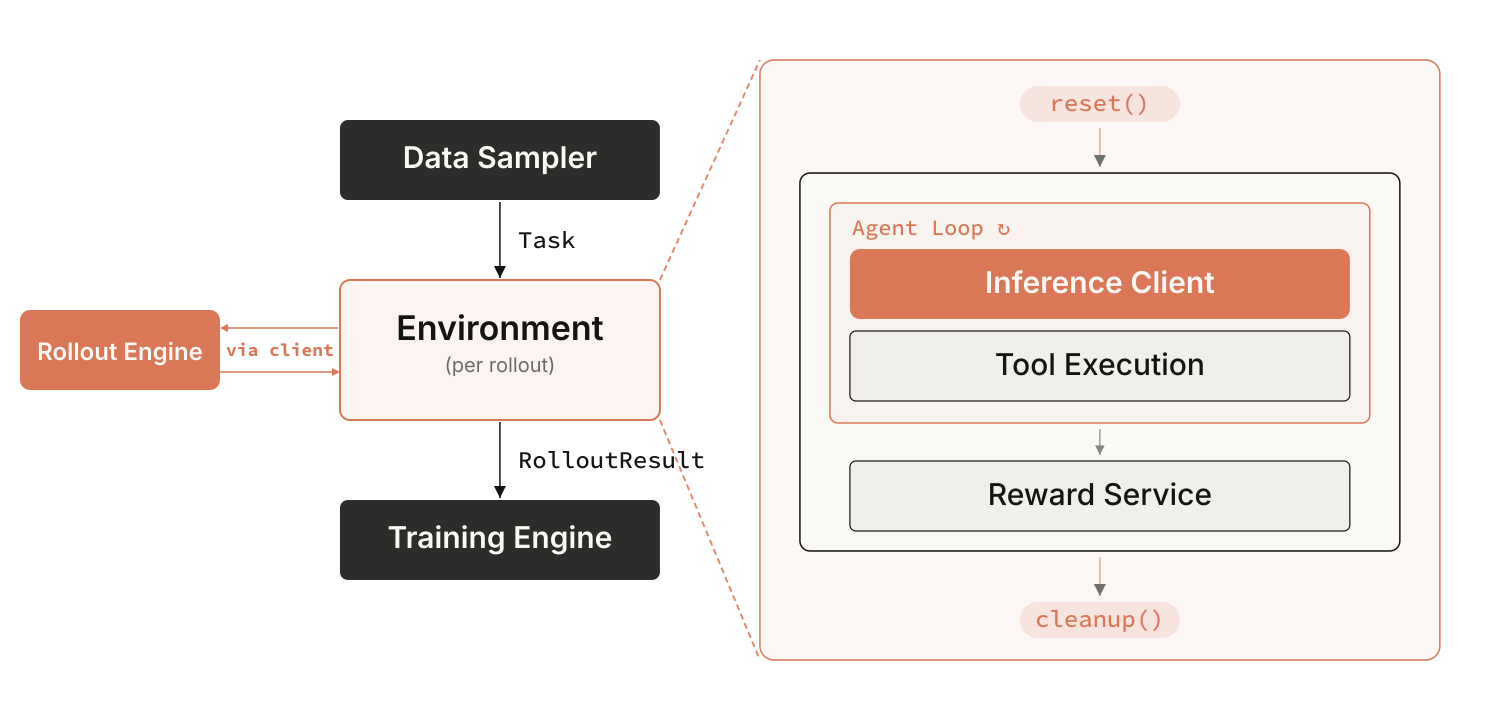
Figure 9, PDF p. 26. Original author figure from arXiv HTML v1. Explain what travels in the RolloutResult arrow and why a runtime failure must be distinguished from an unsuccessful solution.
Evidence to inspect
| Comparison | Reported result | How to interpret it |
|---|---|---|
| Final Rufus-Air vs. official GLM-4.5-Air | IFBench 76.9 vs. 33.6; SWE-bench Verified 65.6 vs. 50.6 | Same-harness comparison of complete recipes; does not isolate a component. Table 1, p. 5. |
| General Agent vs. its starting IF RL checkpoint | MCP-Atlas 34.95 → 42.75; Tau2-Retail 74.00 → 83.80 | A local stage comparison. Tau2 uses the Sonnet 4.5 simulator here; the headline table uses Sonnet 5. Table 10, p. 18. |
| Coding Agent vs. General Agent | SWE-bench Verified 65.60 → 67.80 | This stage ended at its compute budget. The final model returns to 65.6, and the report cannot attribute that later movement to Search Agent or RLHF individually. Table 11, p. 19; §3.6, p. 20. |
| Search Agent advantage ablation | Mean-only advantages lead at matched held-out evaluations | A focused comparison supporting preservation of reward-gap magnitude under a noisy judge; it does not validate the whole stage order. §3.7, p. 21. |
All numeric scores above are percentages. For the measurements and qualifications, read Table 1, Tables 10–11, and §3.7.
Reading route
- Predict the recipe: pp. 3–6, especially Figure 1 and Table 2. Write down what you think each stage adds.
- Follow the learning signal: §3.1–3.4, pp. 6–17. For each stage, identify the filter, reward, and checkpoint selection criterion.
- Follow an agent episode: §3.5–3.8 and §4, pp. 17–27. Keep model errors, reward errors, and infrastructure errors distinct in your map.
- Audit the conclusions: §5–6, pp. 28–31; Appendix B, p. 43; Appendix E–F, pp. 46–47. Check harnesses, simulator choices, sample counts, and compute before comparing results.
Reconstruct your own draw.io note
The starter diagram has two editable pages: the checkpoint pipeline and the agent rollout loop. Close this guide and reconstruct both. On the first, annotate each stage with its data filter, reward, and measured target. On the second, mark sampled tokens, tool observations, loss masks, reward, and termination reasons. Add a question mark to every claimed causal link that lacks an ablation.
Use OneNote for a derivation of why equal rewards cancel under the group-mean baseline, your interpretation of the stage order, and unresolved questions. Keep your personal notes linked privately when needed.
Recall questions
- Why do all-pass and all-fail groups lose reward-driven learning signal, and which stage retains initially all-fail tasks?
- Why is IF RL’s position compatible with the authors’ stage-order principle even though later stages have deterministic rewards?
- What must cross the environment-to-trainer boundary to preserve an on-policy trajectory, and why should aborted rollouts be removed before computing group advantages?
Answer before reopening the source. Review after one day and one week; these are suggested review intervals, not scheduled notifications.
Compare with MiMo
Our synthesis: MiMo emphasizes rollout scale, task and harness diversity, and richer groupwise grading within a mixed training system. Rufus-Air emphasizes a serial curriculum, learnability filtering, and maintaining trajectory fidelity across stage handoffs. Both make reward quality and training infrastructure central, but they do not compare mixed training against serial training under matched budgets. Read the shared survey.
Your reading corrections
After reading, record the claim you would revise, the page that changes your view, and the unanswered question you want investigated. Send your revised diagram back with those corrections so the guide and survey can be updated together.